


What comes to mind when you hear the words “solar watch”? A huge stone sundial from Roman times? Today we look at its modern counterpart: a wristwatch powered by light. Here is what solar watches are, how they work and which brands lead the way.
What is a solar watch?
A solar watch converts light into electricity. A small solar cell on or beneath the dial captures light and powers the movement. The energy is stored in a rechargeable battery, so the watch keeps running in the dark.
Modern solar watches also charge from artificial light, such as indoor lighting. Their big advantage is that they can run for many years without a battery change. They appeal to people who prefer a more sustainable lifestyle and to anyone who simply doesn't want to worry about batteries or winding.

The first solar watches
The first modern solar watch, the Synchronar, was created by inventor Roger Riehl at the end of the 1960s and reached the market in the early 1970s. With its futuristic “space age” look, solar cells on top and a digital display on the side, it was revolutionary for its time and became a cult object among collectors.
In 1976 Citizen introduced the Crystron Solar Cell, one of the first analog watches powered by light. Its dial was dominated by solar panels, which gave it a distinctive look. This model sparked Citizen's long-term interest in light-powered watches, which later led to its famous Eco-Drive technology.
Solar watches today
“Solar” only describes how a watch is powered. Today solar watches can be classic analog models, rugged digital watches or even smartwatches with dozens of features. Technology and design trends have changed their look completely: solar cells are now usually hidden beneath a light-permeable dial.
Iconic solar technologies
Citizen Eco-Drive
Citizen's Eco-Drive is probably the best-known solar technology, with solar cells hidden under the dial. Today the brand offers hundreds of Eco-Drive models, from sporty chronographs to elegant women's watches. See our Citizen watches.
Casio Tough Solar
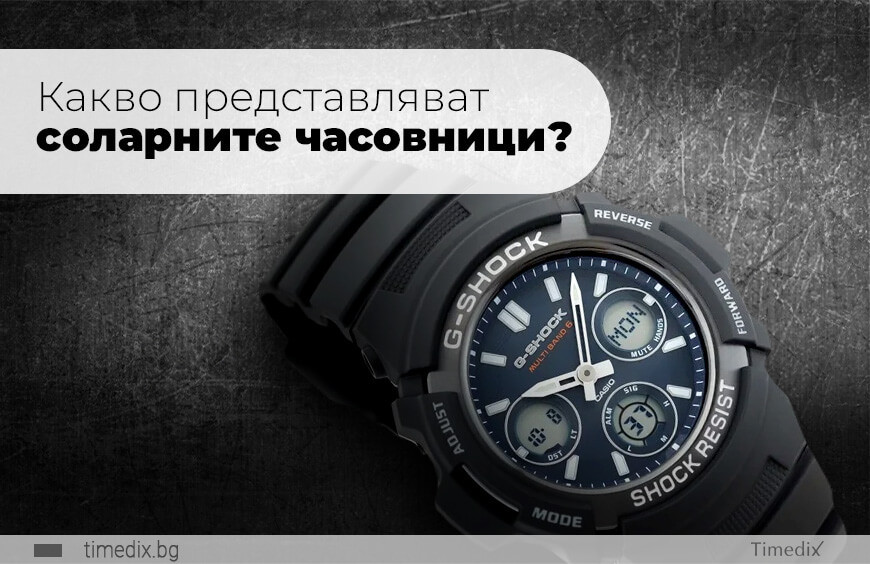
Casio's Tough Solar uses compact solar cells that can be built into almost any model and charge even in relatively weak light. Many iconic Casio models, including G-Shock, are available with solar power, such as the G-Shock Wave Septor Solar AWG-M100SB-2AER. Browse all Casio watches.
Seiko Solar
Seiko's solar quartz movements are accurate and practical: many models run for months on a single full charge, so they won't stop if you leave the watch in a drawer for a while. Explore our Seiko watches.
Frequently asked questions
Do solar watches work without direct sunlight?
Yes. They charge from any sufficiently bright light, including indoor lighting, although sunlight charges them much faster. Wearing the watch with your sleeve uncovered is usually enough to keep it charged.
Does the battery in a solar watch ever need replacing?
Rarely. The rechargeable cell typically lasts many years. If the watch no longer holds a charge after long exposure to light, a watchmaker can replace the rechargeable cell.
Is a solar watch quartz or mechanical?
A solar watch is a quartz watch. It keeps quartz accuracy but uses light instead of a disposable battery. Read more in quartz vs mechanical watch.
Conclusion
Solar watches suit almost everyone: more affordable than fine mechanical watches, more convenient than standard quartz because they rarely need a battery, and very accurate and reliable. Find your light-powered watch among our men's and women's watches.